The Abode of
Guruvayurappan
Discover the sacred origin, divine journey and centuries of history behind Guruvayur — where the four-armed form of Mahavishnu is worshipped with the loving bhava of Unnikrishnan.
Moolavigraha
Chaturbāhu Mahavishnu
Devotional Bhava
Unnikrishnan (Vatsalyam)
Sacred Stone
Pathalanjana Shila
Origin Account
Guru & Vayu (Dwarka)
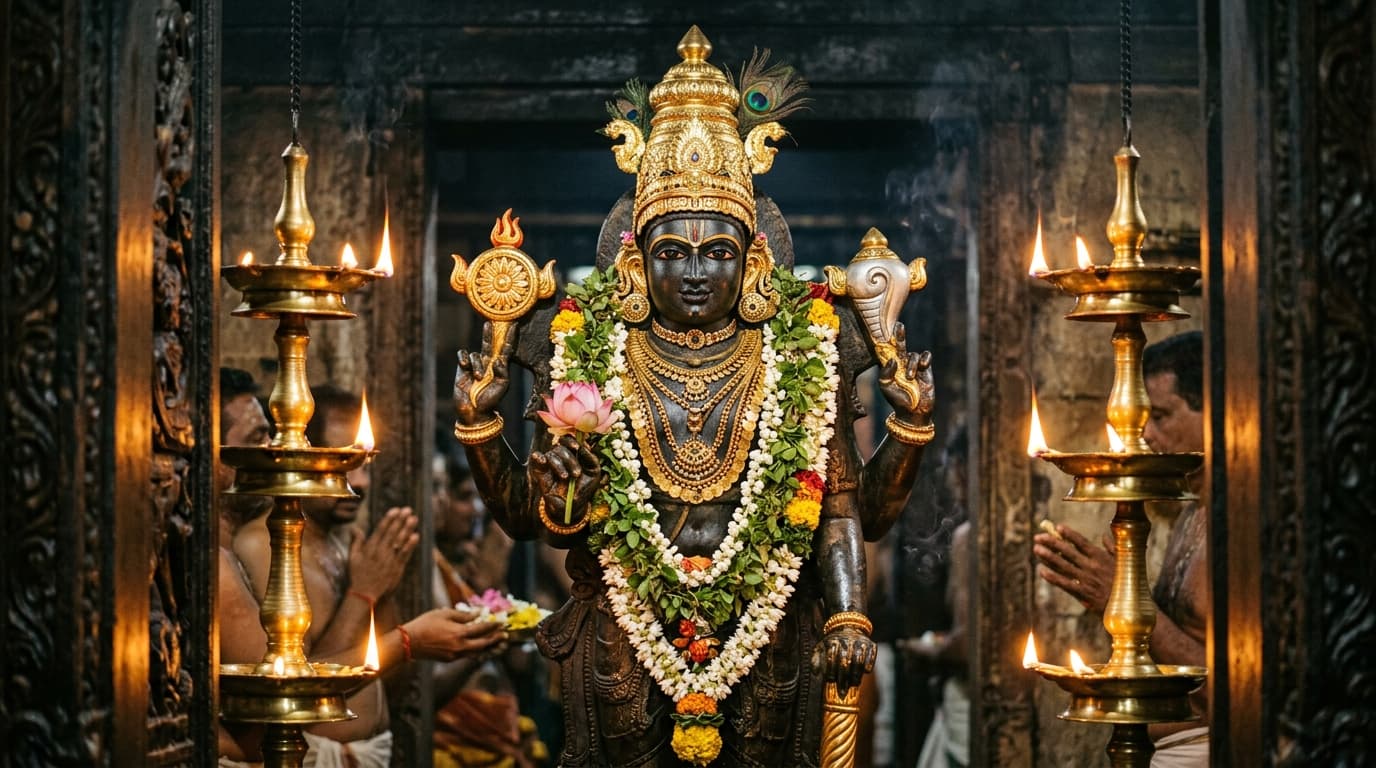
Visual depicts an artistic devotional representation of the Chaturbāhu Mahavishnu form as revered at Guruvayur.
Who is Guruvayurappan?
A profound synthesis of cosmic majesty and intimate maternal love. Understanding the presiding deity requires exploring the form, the divine identity, and the devotional heart.
"The form is Mahavishnu. The divine identity is Krishna. The devotional relationship is Unnikrishnan."
The principal *moolavigraha* (sanctum deity) enshrined in Guruvayur is a standing, four-armed (*Chaturbāhu*) form of **Lord Mahavishnu**, carved from the extremely rare, sacred, and cooling stone known as **Pathalanjana Shila**.
According to the temple’s sacred tradition, this vigraha represents the exact transcendental cosmic form that **Lord Krishna revealed to his parents Vasudeva and Devaki** inside Kamsa's prison in Mathura at the moment of his birth, before veiling his cosmic splendour into the tender human infant form.
Iconographic Form
Chaturbāhu Mahavishnu
Four-armed cosmic sovereign
Divine Identity
Lord Sri Krishna
Dwarkadhish & Purna Avatar
Devotional Bhava
Unnikrishnan
Loving child of every devotee
Pathalanjana Shila
Rare medicinal stone sanctified through millennia of oil, milk, and herbal abhishekams.
Iconographic Details
The Four Divine Weapons & Emblems
Each of the four hands of the Chaturbāhu moolavigraha holds a profound spiritual emblem guiding humanity towards truth and liberation.
Panchajanya Shankha
The Divine Conch of Cosmic Resonance
Held in the upper left hand, the sacred conch represents the primordial sound (Pranava / Om), purity, and the spiritual awakening that dispels darkness and ignorance.
Sudarshana Chakra
The Wheel of Cosmic Order & Righteousness
Held in the upper right hand, the blazing celestial discus symbolizes cosmic preservation, dharma (universal righteousness), the relentless wheel of time (Kala), and supreme divine protection.
Kaumodaki Gada
The Mace of Spiritual Authority & Strength
Held resting in the lower right hand, the divine mace represents supreme physical and spiritual power, intellect, and the destruction of negative karmas, pride, and ego.
Padma
The Blossom of Spiritual Transcendence
Held delicately in the lower left hand, the holy lotus represents non-attachment, divine purity blooming above worldly waters, cosmic manifestation, and unconditional grace.
The Sacred Origin of Guruvayurappan
A divine journey from Narayana to Guruvayur — tracing the 14 sacred milestones of the moolavigraha according to the revered temple Sthala Purana.
The Consecration by Guru & Vayu
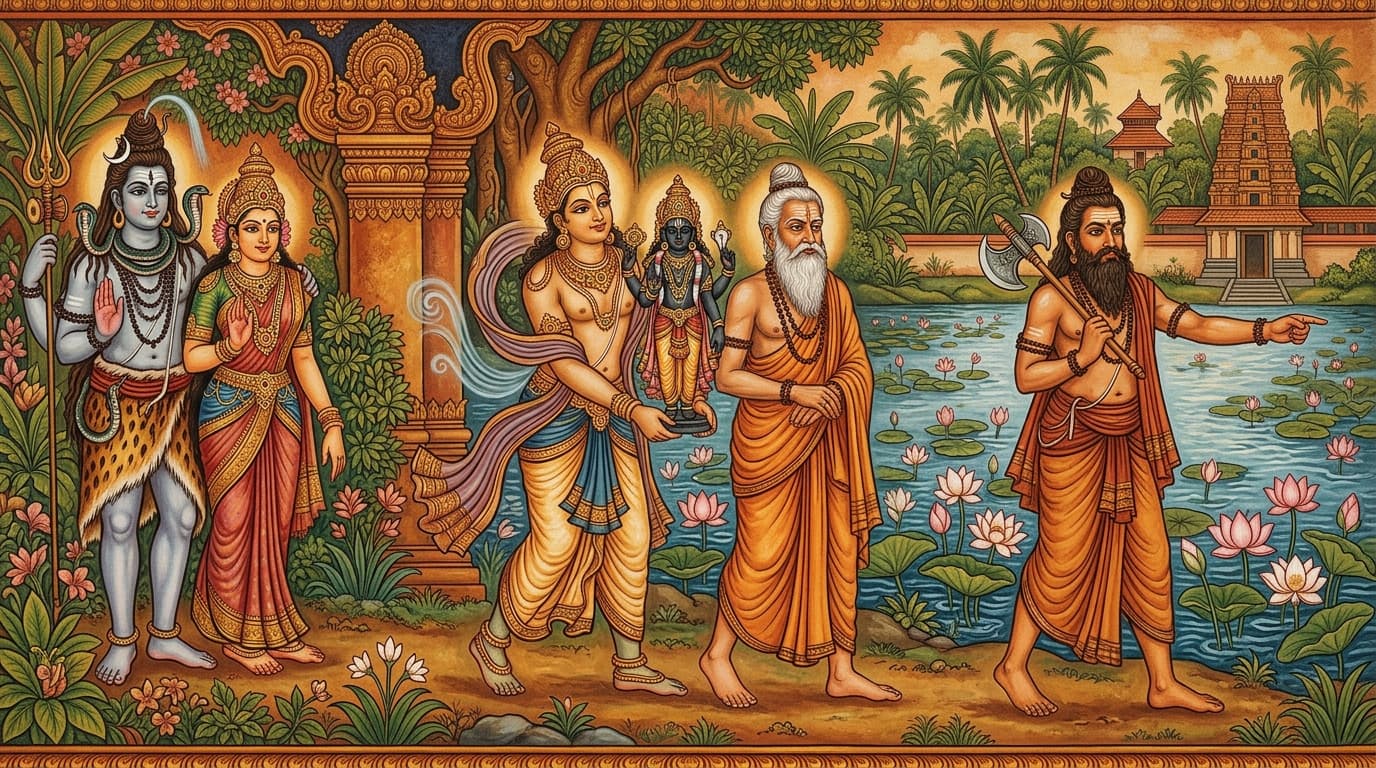
When the golden city of Dwarka was submerged by the cosmic ocean, Brihaspati (Guru) and Vayu retrieved the floating idol. Guided south to Kerala by Sage Parashurama, Lord Shiva blessed the sacred spot beside the lotus lake and moved to Mammiyoor so the image could be consecrated.
Chronological Sthala Purana
14 Sacred Epochs of the Moolavigraha
Stage 1 of 14
Narayana in Vaikuntha
According to the sacred Sthala Purana, the sacred vigraha carved from the rare and holy Pathalanjana Shila stone was originally worshipped in Vaikuntha by Lord Narayana himself.
Note on Sacred Tradition: The 14 stages described above represent the sacred Sthala Purana (traditional temple lore) cherished by millions of devotees for centuries, distinguished from modern archaeological chronologies.
Tradition & History
Distinguishing sacred devotional tradition from historically and archaeologically documented records with nuance, clarity, and reverence.
Sacred Tradition (Sthala Purana)
Faith, oral transmission, and scriptural narratives
- ✓The holy moolavigraha is believed to have originated in Vaikuntha and was passed down through Brahma, Sutapa-Prishni, Kashyapa-Aditi, and Vasudeva-Devaki.
- ✓Personally worshipped by Lord Krishna in Dwarka for hundreds of years during the Dvapara Yuga.
- ✓Rescued from the deluge of Dwarka by Brihaspati (Guru) and Vayu Bhagavan under Krishna's instructions.
- ✓Installed in Kerala with the blessings of Lord Shiva, who moved to Mammiyoor to accommodate the shrine.
- ✓Traditional lore reveres the temple as an eternal spiritual vortex spanning cosmic yugas.
Historically Documented Evidence
Surviving literary records, inscriptions, and modern documents
- ✓The earliest verifiable literary reference to the temple appears in the 14th-century Tamil text 'Kokasandesam', where it is referred to as 'Kuruvayur'.
- ✓During the 16th century, under the patronage of the Zamorin of Calicut and royal chieftains, Guruvayur expanded into a premier pilgrimage hub in South India.
- ✓In 1587 CE, Melpathur Narayana Bhattathiri composed the monumental Sanskrit devotional masterpiece 'Narayaneeyam' in the temple's sanctum.
- ✓Official records document attacks and fires in 1716 (Dutch plundering) and 1789 (Tipu Sultan campaign), prompting the safe relocation of deities to Ambalappuzha.
- ✓The historic Guruvayur Satyagraha of 1931–1932 led by K. Kelappan was a monumental milestone for temple-entry and caste-reform rights across Kerala.
Why this distinction matters for pilgrims and historians
While archaeological findings date the existing physical structure to the medieval era, the spiritual continuity of the sacred idol and its living worship traditions carry the profound devotion of millions across epochs.
Why is Guruvayurappan called Unnikrishnan?
The extraordinary devotional secret of Guruvayur: where the majestic cosmic creator is worshipped as an innocent, playful infant.
The Murti Does Not Physically Transform — The Devotional Relationship Does
In Hindu temple worship, the consecrated murti in the sanctum permanently maintains the rigorous iconographic attributes of the four-armed Chaturbāhu Mahavishnu. However, through the nectar of **Vatsalya Bhava** (parental devotion), devotees experience him as their very own child.
Chaturbāhu Mahavishnu
Four divine arms bearing Conch, Discus, Mace, and Lotus carved in sacred Pathalanjana Shila.
Sri Krishna Revelation
The identical cosmic vision shown to Vasudeva & Devaki in Mathura before assuming infant form.
Unnikrishnan (Child)
The sweetest communion of the heart where the Supreme Lord becomes the child of every seeker.
Sacred Nomenclature
The Four Affectionate Names of the Deity
Guruvayurappan
The Lord / Father of GuruvayurCombines 'Guru' + 'Vayu' + 'Appan' (meaning Father or Sovereign Lord in Malayalam). Expresses reverence for the supreme protector who nurtures and shields all devotees.
Unnikrishnan
The Beloved Child Krishna'Unni' denotes a tender, beloved little child. It signifies experiencing the supreme reality not with distant fear or formality, but with the boundless intimacy of parental affection.
Unnikannan
The Sweet Eyes of Infant KrishnaAn affectionate pet name widely used across Kerala households to call upon the playful, butter-stealing child deity who listens to every mother's prayers.
Guruvayur Unni
The Infant of the SanctumImmortalized by Saint Poonthanam, who found solace in little Krishna after losing his infant child: 'When the divine child plays in our heart, why grieve for others?'
Temple History & Chronology
From medieval literary mentions to the great Bhakti poets, historic invasions, social reform movements, and the miraculous survival of the 1970 fire.
The Great Fire & Miraculous Protection of the Sanctum
At 1:00 AM on 30 November 1970, a massive blaze broke out in the western Chuttambalam. The fire raged furiously for five hours, destroying wooden cloistered galleries and tiled roofs. In a legendary display of communal unity, thousands of people from all faiths rushed together from neighboring villages to battle the flames.
Miraculously, the fire halted at the threshold of the inner sanctum: the Sreekovil, the Chaturbāhu idol, and the Vigrahas remained completely unharmed.
Duration of the blaze before heroic collective efforts extinguished the inferno.
Earliest Literary Reference in Kokasandesam
The 14th-century Tamil sandesha-kavya 'Kokasandesam' contains the earliest known historical textual mention of 'Kuruvayur' and its revered Vishnu shrine.
Melpathur Composes the Sacred Narayaneeyam
Afflicted by severe rheumatism, the great scholar Melpathur Narayana Bhattathiri sat in the temple courtyard and composed 1,036 Sanskrit verses summarizing the Bhagavata Purana in 100 days.
Poonthanam & Vernacular Malayalam Bhakti
Poonthanam Namboothiri composed 'Jnanappana' (The Song of Divine Wisdom) in pure Malayalam, proving that sincere pure devotion (*bhakti*) transcends rigid scholarly orthodoxy.
Dutch Invasion & Plunder
Dutch colonial forces attacked Guruvayur, plundered temple treasures, and set fire to portions of the outer structures before being repelled by local defenders.
Reconstruction & Structural Expansion
Extensive renovation of the Chuttambalam, Nalambalam, and roof copper sheeting was completed under the leadership of regional chieftains and the Zamorin.
Hyder Ali & Tipu Sultan Invasions
During the military incursions into Malabar, temple priests and devotees hid the main utsava vigraha and wealth, safely transporting them to Ambalappuzha Sri Krishna Temple.
The Historic Guruvayur Satyagraha
Led by nationalist leaders K. Kelappan, A.K. Gopalan, P. Krishna Pillai, and supported by Mahatma Gandhi and K.P. Kesava Menon, activists launched an epic 10-month satyagraha demanding temple entry for all castes.
Universal Temple Entry Proclamation
The Madras Government passed the Temple Entry Authorization Act, officially throwing open the sacred gates of Guruvayur Temple to all Hindus regardless of caste.
The Great Fire & Miraculous Protection
On 30 November 1970, a devastating fire broke out at 1:00 AM in the western Chuttambalam. Fire raged for five hours destroying wooden cloistered corridors. People of all religions united heroically to douse the flames. The innermost Sreekovil and the Chaturbāhu idol remained completely untouched.
Global Pilgrimage Sanctuary
Today, Guruvayur stands as one of India's most visited spiritual sanctuaries, hosting over 10 million pilgrims annually, performing hundreds of traditional weddings daily, and managing extensive cultural and welfare trusts.
Temple Architecture & Vastu
A masterpiece of classical Kerala sacred architecture — built in harmony with nature, teak timber acoustics, laterite stone, and the divine geometry of Tantric Vastu.
The Fortress of Ten Thousand Lamps
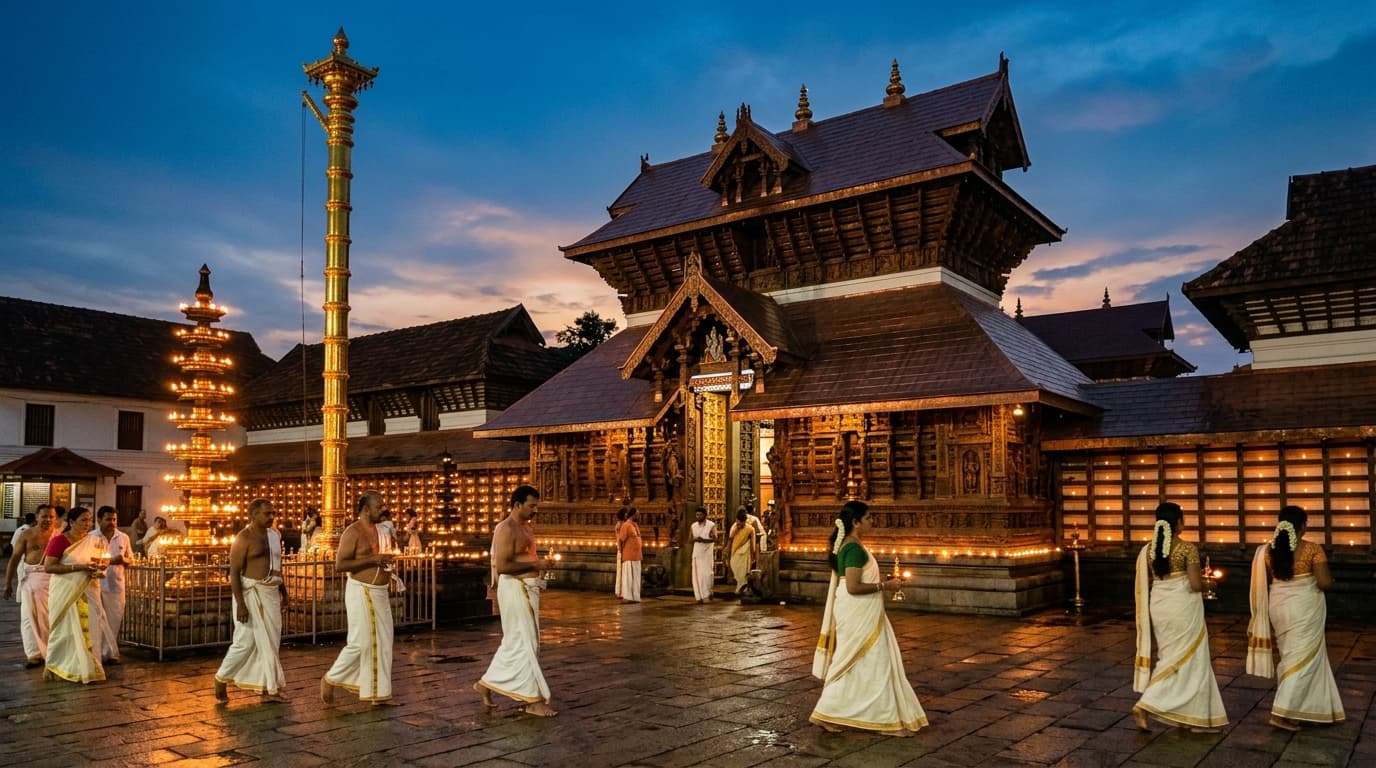
During the evening Deepalankaram, over 10,000 brass lamps mounted upon the outer wooden framework (Vilakkumadam) are lit with pure oil. The entire sanctum glows like a golden celestial palace against the dusk sky of Kerala.
Sreekovil
The innermost sanctum housing the sacred four-armed moolavigraha. Built on an elevated granite foundation with a copper-plated square roof crowned by a golden Stupika (Kalasham).
Nalambalam
The rectangular pillared hall surrounding the Sreekovil. Accommodates the Thidappally (temple kitchen for sanctified naivedyam) and the Namaskara Mandapam.
Chuttambalam
The expansive outer perimeter walkway facilitating the sacred pradakshina (circumambulation) of the deities amidst chanting of hymns.
Vilakkumadam
An intricate multi-tiered timber framework mounted with over 10,000 brass oil lamps surrounding the outer walls of the Nalambalam.
Deepastambam
Magnificent 24-foot tall brass and granite lamp pillars standing proud at the eastern and western entrance courtyards.
Kodimaram (Dhwajastambam)
The 110-foot tall sacred flagstaff covered entirely with pure gold plating, standing directly in line with the sanctum sanctorum.
Kizhakkedathu Gopuram
The majestic principal gateway opening into the East Nada, welcoming millions of devout pilgrims every year.
Guruvayur & the Bhakti Tradition
How Sanskrit scholarship, vernacular Malayalam poetry, and immortal saint-devotees transformed Guruvayur into the cultural heart of Krishna devotion.
Melpathur Narayana Bhattathiri
Author of Srimad Narayaneeyam
Afflicted with debilitating rheumatism, the prodigious scholar Melpathur sat before the sanctum sanctorum and composed 1,036 melodious Sanskrit verses condensing the entire Bhagavata Purana in 100 days. On the 100th day, tradition records that he was cured and had a divine vision of the four-armed Lord.
Poonthanam Namboothiri
Author of Jnanappana (Song of Wisdom)
Writing in simple, melodious Malayalam accessible to ordinary people rather than dense Sanskrit, Poonthanam embodied pure, unpretentious devotion. When his infant child passed away, he sublimated his grief into an eternal embrace of little Krishna (Unnikrishnan).
The Visionaries of Guruvayur Lore
Vilwamangalam Swamiyar II
Sree Krishna Karnamrutham
A divine visionary ascetic blessed with inner vision who could perceive the living presence of Lord Krishna playing throughout the temple precincts during daily worship.
Kururamma
Vatsalya Bhava Tradition
A childless widow whose ecstatic motherly love for Guruvayurappan was so pure that tradition recounts the divine child helping her with daily household chores and playing at her side.
Manavedan Raja (Zamorin of Calicut)
Krishnageethi & Krishnanattam
The devout Zamorin King who had a divine vision of Lord Krishna under the Elanji tree at Guruvayur and created 'Krishnanattam', the 8-night sacred dance-drama offered exclusively at the temple.
Festivals & Living Traditions
From the divine night of Guruvayur Ekadasi to the exhilarating Anayottam elephant race and Carnatic music traditions.
Guruvayur Ekadasi
The most sacred day at the temple, coinciding with the revelation of the Bhagavad Gita (Geetha Dinam). The entire temple glows with tens of thousands of brass lamps.
Ritual Significance: Devotees observe complete fast and night vigil. Elephant processions (Udayasthamana pooja) and grand Panchavadyam are performed.
Learn More & SchedulesChembai Sangeetholsavam
A legendary 14-day Carnatic music festival honoring the great vocalist Chembai Vaidyanatha Bhagavathar, featuring thousands of classical musicians performing before the deity.
Ritual Significance: Concludes on Ekadasi night with the mass community rendition of the sacred Pancharatna Kritis.
Learn More & SchedulesAnnual Temple Ulsavam & Anayottam
The 10-day grand annual festival commencing with 'Anayottam' (the traditional elephant race) from Manjulal to determine which elephant carries the holy Thidambu.
Ritual Significance: Features flag hoisting (Kodiyettam), daily Pallivetta, and concludes with the holy immersion bath (Arattu) in the temple tank.
Learn More & SchedulesVishu Kani
The auspicious Kerala New Year. Thousands of pilgrims line up overnight to view the glorious 'Vishu Kani'—the deity illuminated amidst golden Kanikkonna flowers, cucumber, rice, fruits, and mirrors.
Ritual Significance: Believed to bring prosperity, spiritual auspiciousness, and peace for the entire upcoming year.
Learn More & SchedulesAshtami Rohini (Janmashtami)
The divine birthday celebration of Lord Krishna. The sanctum is adorned with fragrant flower garlands, Appam and Palpayasam feasts are distributed to tens of thousands of devotees.
Ritual Significance: Grand Shobha Yatras (devotional processions with children dressed as Unnikrishnan) fill the holy streets of Guruvayur.
Learn More & SchedulesKrishnanattam
A sacred classical dance-drama created by King Manavedan depicting the complete life of Krishna across eight cycles: Avataram, Kaliamardanam, Rasakreeda, Kamsavadham, Swayamvaram, Banayuddham, Vividavadham, and Swargarohanam.
Ritual Significance: Offered by devotees for prosperity, children, recovery from illness, and spiritual liberation.
Learn More & SchedulesThe Sacred Connection with Mammiyoor
According to the founding legend of Guruvayur, Lord Shiva and Goddess Parvati were originally dwelling beside the serene lotus lake of Rudratheertham. When Guru and Vayu arrived carrying the sacred idol of Mahavishnu from submerged Dwarka, Lord Shiva magnanimously blessed the consecration of Vishnu's shrine at that exact spot and shifted his own sanctum across to Mammiyoor.
Revered for Lord Shiva with Goddess Parvati, Lord Ganesha, Ayyappa, and Subramanya shrines in peaceful heritage surroundings.
The Historical Timeline
A chronological panorama of Guruvayur from the cosmic origins of Sthala Purana through medieval epochal milestones to the present day.
Divine Consecration
Guru and Vayu consecrate the sacred Chaturbāhu Mahavishnu idol beside Rudratheertham.
Kokasandesam Reference
Earliest known literary record referencing 'Kuruvayur' and its revered Vishnu shrine.
Narayaneeyam Composed
Melpathur Narayana Bhattathiri writes the immortal 1,036-verse Sanskrit hymn.
Dutch Attack & Defense
Temple defenders protect the sanctum against Dutch plundering; security fortified.
Grand Reconstruction
Complete architectural restoration standardizing the Kerala Vastu layout.
Tipu Sultan Incursion
Utsava vigraha safely concealed and protected at Ambalappuzha Temple.
Guruvayur Satyagraha
K. Kelappan and social reformers lead an epic struggle for temple entry rights.
Universal Temple Entry
Temple entry proclamation formally opens sacred doors to all Hindu devotees.
The Great Fire Survival
Heroic interfaith firefighting saves the sanctum sanctorum on 30 Nov 1970.
Living World Sanctuary
One of India's most visited sanctuaries hosting over 10 million pilgrims each year.
Frequently Asked Questions
Clear, authentic, and historically accurate answers regarding Guruvayurappan, temple origins, rituals, and traditions.
Experience the Sanctity of
Guruvayur
From physically verified hotel rooms near the temple to darshan schedules and local pilgrimage services — HelloGuruvayur is your trusted companion.
Hotels Near Temple
Verified stays within walking distance of East & West Nada.
Temple Timings
Daily pooja schedules from Nirmalyam to Athazha Pooja.
Darshan Guide
Queue guidance, senior citizen darshan, and dress code.
Temple Weddings
Auditoriums, wedding photography, and traditional decor.