The Story of
Guruvayur
From the sacred idol's journey from Dwaraka to the temple that became one of Kerala's greatest centres of Krishna devotion.
A journey through legend, devotion, history and living tradition.
Before Guruvayur Had a Name
The story traditionally associated with Guruvayur begins long before the present temple town existed. The sacred history of the shrine is preserved through Hindu scriptures, Guruvayur Mahatmya, and generations of oral memory, while the physical temple and its cultural institutions have their own documented historical evolution spanning medieval centuries.
The Journey of the Divine Idol
According to temple lore and Hindu scriptures, the four-armed deity was fashioned by Mahavishnu in Vaikuntha, passed to Brahma, worshipped across three successive incarnations of the Lord, revered in Sri Krishna's royal sanctum at Dwaraka, and carried south by Brihaspati and Vayu as Dwaraka submerged into the Arabian Sea.
Centuries of Devotion & Architecture
Documentary records, medieval Sanskrit Sandesha Kavyas, Zamorin royal patronage, the monumental 1587 composition of Narayaneeyam, temple-entry social reforms, and the extraordinary communal unity that saved the sanctum during the 1970 fire define Guruvayur's recorded history.
The Divine Image of Mahavishnu
According to the Guruvayur Mahatmya, the origin of the sacred image is divine. Mahavishnu Himself is believed to have fashioned the four-armed deity from dense, lustrous Padmaraga stone and presented it to Lord Brahma to assist in cosmic creation.
Desiring progeny devoted to righteousness, the pious royal sage Sutapas and his consort Prishni undertook thousands of years of arduous tapasya in Satya Yuga. Pleased by their austere devotion, Lord Brahma gifted them the sacred Mahavishnu idol.
The Same Lord, Three Successive Births
When Mahavishnu appeared before Sutapas and Prishni, granting any boon they desired, the couple prayed in pure absorption: 'May we have a son just like You!' The Lord granted their prayer, promising to be born to them across three consecutive earthly incarnations.
In their first birth, the Lord was born as Prishnigarbha. In their second birth as Kashyapa and Aditi, the Lord manifested as the divine dwarf Vamana. In their third incarnation during Dvapara Yuga as Vasudeva and Devaki in Mathura, the Lord incarnated in His full majesty as Sri Krishna.
"Three times you prayed for a son equal to Myself; three times I shall be born to you to fulfill your selfless devotion."
Krishna Worshipping the Sacred Image in Dwaraka
After liberating His parents Vasudeva and Devaki from Kamsa's captivity in Mathura, Sri Krishna established His golden capital of Dwaraka on the western sea. The sacred image was brought to Dwaraka and consecrated within Krishna's private residential palace.
Every morning, before attending to royal assemblies and cosmic duties, Krishna Himself performed devotional poojas and offered fresh flowers to this ancient four-armed Vishnu deity, establishing its unparalleled spiritual sanctity.
The Submergence of Dwaraka &
Uddhava's Sacred Mission
According to the Srimad Bhagavatam and Guruvayur tradition, as the Dvapara Yuga drew to an end, Sri Krishna foresaw that His golden island citadel of Dwaraka would be swallowed by the rising waters of the Arabian Sea. Krishna instructed His beloved disciple and minister, Uddhava, that the sacred four-armed idol of Vishnu—which Krishna had worshipped in His private sanctum—must be rescued and reinstalled on earth to provide solace to humanity during the impending trials of Kali Yuga.
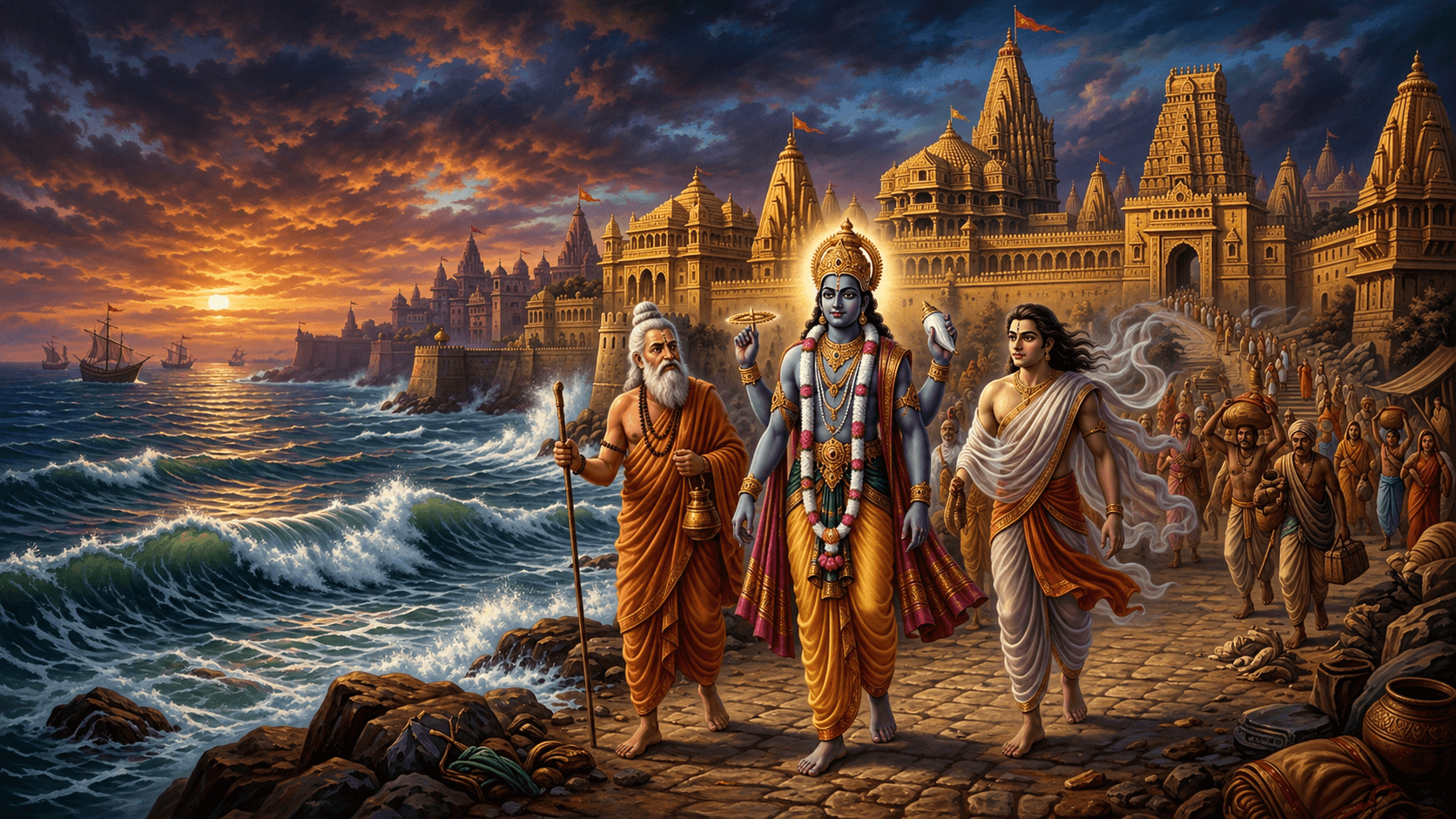
Artistic interpretation of the traditional account: Uddhava, Brihaspati (Guru), and Vayu Deva rescuing the sacred four-armed idol as ancient Dwaraka is claimed by the sea.
Uddhava's Entrustment
Unable to carry the divine mission alone, Uddhava prayed to Brihaspati (Guru, preceptor of the Gods) and Vayu Deva (the Wind God) to guide the sacred image southward.
The Flight of Guru & Vayu
Vayu lifted the sacred image on swift cosmic currents while Brihaspati provided spiritual guidance across the length of Bharatvarsha in search of a consecrated sanctuary.
Parashurama's Welcome
Upon reaching the lush Malabar coast, Sage Parashurama (creator of Bhargava Kshetra) welcomed Guru and Vayu, directing them toward a tranquil, lotus-filled lake.
According to the sacred tradition, the name Guruvayur honors Guru (Brihaspati) and Vayu Deva who carried the sacred idol, combined with the traditional Malayalam/Dravidian suffix Oor (meaning settlement or sacred abode).
Guru (Preceptor) + Vayu (Wind) + Oor (Land) → Land consecrated by Guru & Vayu
Sage Parashurama Guiding Guru and Vayu
As Brihaspati and Vayu flew southwards across the Deccan plateau, they entered the emerald lands reclaimed from the ocean by Sage Parashurama (the sixth avatara of Vishnu). Parashurama met the divine messengers on the coast and rejoiced upon learning of their mission.
Parashurama guided Guru and Vayu directly to a tranquil, secluded lake surrounded by towering teak, coconut palms, and blossoming lotuses, declaring it the spiritually preordained home for Sri Krishna's deity.
Lord Shiva and
The Mammiyur Connection
Upon reaching the emerald lake in Kerala, Guru and Vayu discovered that Lord Shiva and Goddess Parvati were already performing cosmic penance on its tranquil banks. Rather than turning the deities away, Lord Shiva joyfully welcomed them, declaring that the sacred lake—subsequently venerated as Rudra Theertha—was the preordained spot on earth for the installation of Mahavishnu's idol.
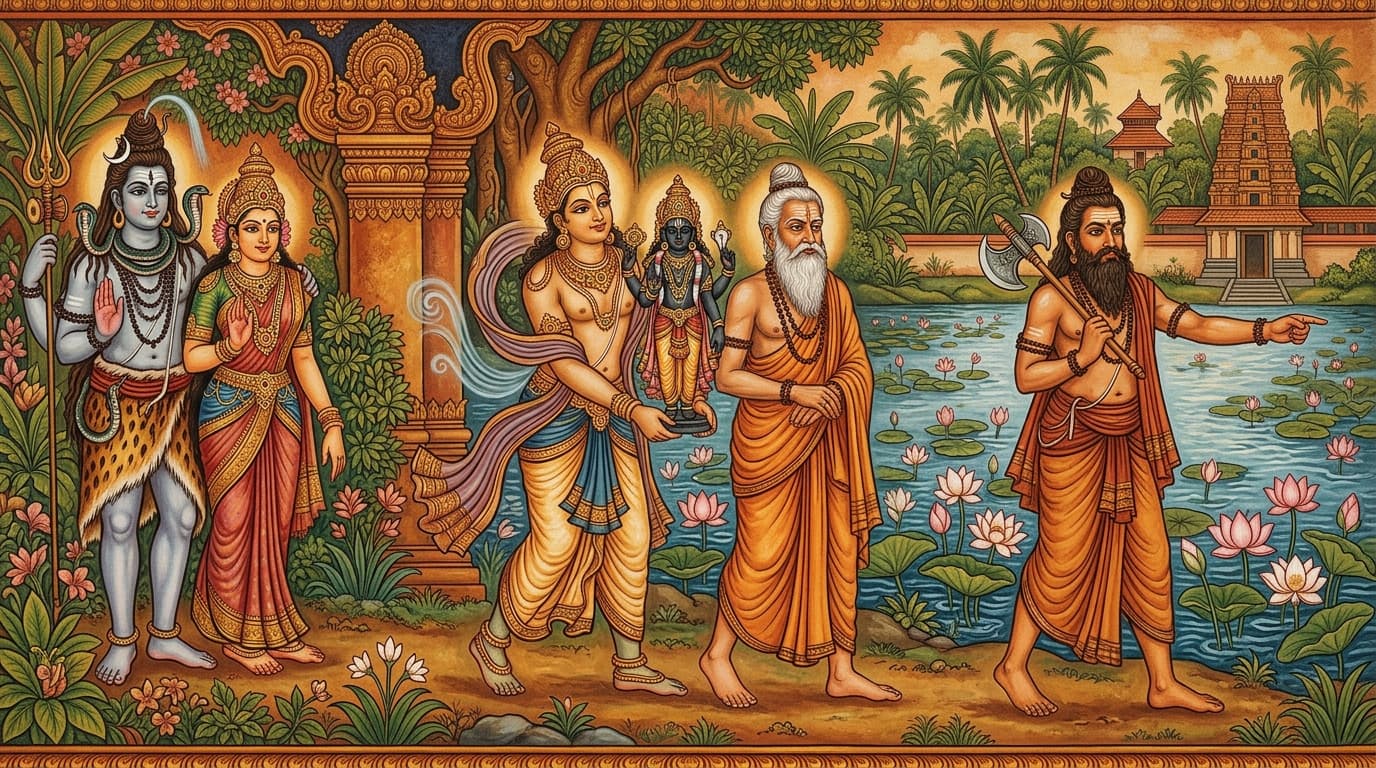
Artistic depiction: Brihaspati and Vayu installing the sacred Vishnu deity at the lotus lake with celestial blessings from Lord Shiva and Goddess Parvati.
The Relocation to Mammiyur
According to the Sthala Purana, after blessing the consecration, Lord Shiva and Goddess Parvati graciously moved across the northern bank of Rudra Theertha to Mammiyur (Mahimayur, 'the place of great glory'), establishing their eternal presence just 1 km north of Guruvayur.
The Twin Pilgrimage Tradition
Devotees consider a pilgrimage to Guruvayur complete only after paying homage at Mammiyur Mahadeva Temple. In temple ritual tradition, priests performing the night Thrippuka bow northwards toward Mammiyur in reverence to Lord Shiva.
The Sacred Installation by Vishwakarma
Under the guidance of Lord Shiva and Sage Parashurama, the celestial architect Vishwakarma constructed a magnificent Kerala-style sanctum within a single day. Brihaspati (Guru) and Vayu Deva solemnly installed the sacred four-armed idol into the sanctum sanctorum facing east.
Lord Shiva performed the first consecration pooja with fresh lotus flowers from Rudra Theertha while celestials showered flowers from the skies, establishing the eternal presence of Sri Guruvayurappan.
Who Is Guruvayurappan?
Guruvayurappan is worshipped as Lord Krishna, while the installed physical idol itself is traditionally understood and sculpted as the majestic four-armed standing form of Mahavishnu carved from rare, dense Pathalanjana Sila (sacred black stone).
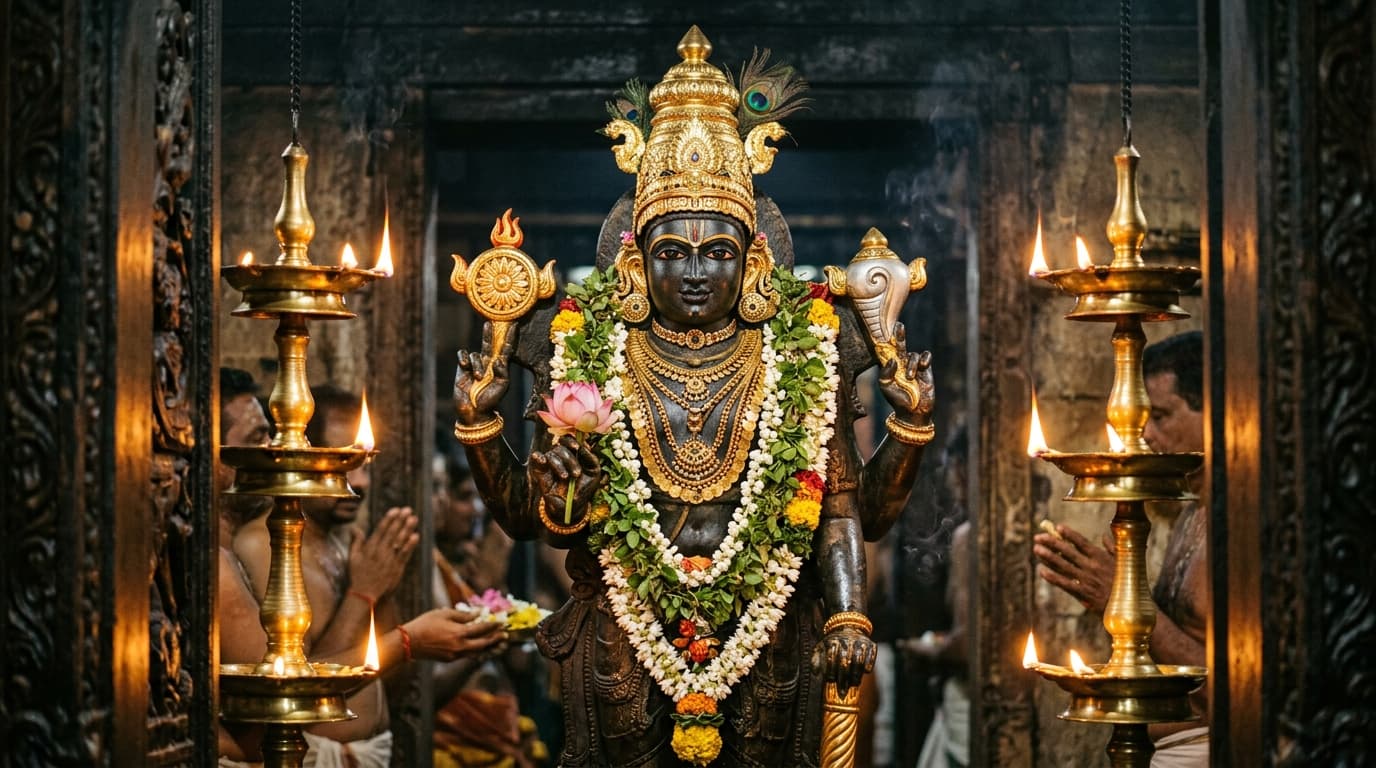
Artistic representation of the presiding deity in the traditional four-armed Chaturbahu Mahavishnu form.
The Four Sacred Weapons & Symbols (Chaturbahu):
Symbolizes the primal cosmic sound (Om) and liberation from darkness.
Symbolizes cosmic time, radiant spiritual intellect, and the dispelling of negative forces.
Symbolizes elemental strength, physical vitality, and sovereign authority.
Symbolizes pure spiritual transcendence, beauty, and unconditional detachment.
Why Do Devotees Call Him Unnikannan?
Although the physical idol represents the sovereign four-armed Vishnu who revealed His cosmic form to Vasudeva and Devaki at birth, devotees approach Guruvayurappan with the tender, intimate love reserved for Unnikannan (the Divine Child Krishna). The tradition preserves both dimensions—the supreme creator and the beloved playful child—without any physical change in the idol.
"One divine identity, approached through different expressions of devotion."
King Janamejaya &
The Healing Sanctuary
In temple lore, King Janamejaya (the grandson of Arjuna and son of King Parikshit) sought to avenge his father's death by conducting the colossal Sarpa Satra (snake sacrifice). Consumed by remorse and afflicted with severe physical ailments and leprosy as a karmic result of destroying innocent serpent lives, Janamejaya fell into profound despair.
The Prescription of Bhakti
The revered Sage Dattatreya appeared before the king, advising him that true liberation from bodily and spiritual affliction lay in total surrender before Guruvayurappan in Kerala.
Penance at Rudra Theertha
Janamejaya travelled south to Guruvayur, bathed daily in the holy waters of Rudra Theertha, and spent one hundred continuous days immersed in unceasing prayer before the deity.
The Divine Darshan
On the final night, Lord Guruvayurappan is believed to have appeared in a luminous vision, completely cleansing the king's skin and restoring him to radiant health and spiritual peace.
From Sacred Story to
Recorded History
The origin story belongs to sacred Puranic memory. The physical temple, its social movements, and its architectural evolution have their own documentary record.
| Dimension / Aspect | ✦ Sacred Tradition (Sthala Purana) | 📜 Recorded History & Documents |
|---|---|---|
| Origin of Sacred Image | Created directly by Mahavishnu in Vaikuntha from sacred Padmaraga stone and worshipped by Brahma, Sutapas, and Krishna. | The idol is a masterpiece of ancient South Indian stone sculpture carved in rare sacred Pathalanjana stone, dating to antiquity. |
| Arrival in Kerala | Rescued from submerged Dwaraka by Brihaspati (Guru) and Vayu Deva, guided by Sage Parashurama to Rudra Theertha. | Reflects the historical southward migration of Vaishnavite devotional traditions into Kerala along ancient coastal trade routes. |
| The Name 'Guruvayur' | Named 'Guru-Vayu-Oor' (the land of Guru and Vayu) to honor the celestial preceptor and the Wind God who installed the idol. | Linguistically documented in medieval Malayalam literature (e.g. Kokasandesam) as Kuruvayur / Kurumbayur. |
| Shiva at Mammiyur | Lord Shiva and Parvati willingly moved to the opposite bank of Rudra Theertha at Mammiyur to provide space for Mahavishnu. | Represents the ancient syncretic harmony between Shaivite and Vaishnavite temple traditions across Central Kerala. |
| Shrine Construction | Constructed in a single day by celestial architect Vishwakarma under the guidance of Lord Shiva and Devas. | Exhibits classical Kerala Indigenous Vastu architecture with layered wooden roofing, granite base, and mural artwork spanning centuries. |
| Healing & Miracles | King Janamejaya cured of leprosy; Melpathur cured of rheumatism upon completing Narayaneeyam. | The temple evolved as an enduring sanctuary of devotional therapeutic solace, inspiring profound Bhakti literature and medical traditions. |
The Bhakti Renaissance &
The Birth of Narayaneeyam
During the 16th and 17th centuries, Guruvayur transformed from a local regional shrine into the undisputed epicentre of Kerala's Krishna Bhakti movement, inspired by scholarly masterworks and deeply emotional vernacular poetry.
Melpathur Narayana Bhattathiri
Afflicted with crippling rheumatism, the Sanskrit polymath sat before the sanctum and composed 1,034 exquisite Sanskrit verses summarizing the Bhagavata Purana, experiencing full recovery on the 100th day.
Poonthanam Namboothiri
Following the tragic loss of his infant son, Poonthanam poured his grief into unconditional devotion, writing the immortal philosophical work Jnanappana in simple, accessible Malayalam.
Vilvamangalam Swamiyar
The mystical saint endowed with inner vision, who perceived Krishna playfully participating in the daily temple ceremonies and helped codify sacred pooja rituals.
Kururamma
An elderly widowed devotee whose profound maternal devotion was so intense that legends record child Krishna appearing before her to assist in household chores.
"Sandranandavabodha-prakrithi-anupamita-kala-desa-avadhibhyam... Tat-tavann-bhati sakshat Gurupavanapure hanta bhagyam jananam!"
("That supreme, limitless Brahman of dense bliss and consciousness, which transcends time and space—how fortunate are the people that It shines directly visible before us in Guruvayur!")
Guruvayur Through the
Storms of History
Throughout the 18th century, the temple weathered military conflicts and political upheavals through resilient diplomacy, strategic safeguarding of its deities, and unswerving community devotion.
Dutch Raid & Initial Destruction
During the Dutch campaigns in Malabar, soldiers raided the temple compound and set fire to portions of the western structures. The Zamorin and local devotees promptly restored the damaged gopuram in 1747.
Hyder Ali's March on Malabar
When Mysore ruler Hyder Ali conquered Malabar, destruction of the temple was averted after temple administrators negotiated a tribute payment (Vatta) of 10,000 fanams to ensure peaceful sanctuary.
Tipu Sultan & The Concealed Deity
Facing advancing Mysore troops, the main stone deity was concealed underground within the sanctum by the Melsanthi. The metallic processional idol (Utsava Vigraham) was secretly transported south to Ambalapuzha Temple.
Reinstallation & Restoration
Following the conclusion of hostilities, the processional deity was joyfully escorted back to Guruvayur with grand temple honors, and the sanctum resumed its unbroken daily rituals.
To this day, a special hall at Ambalapuzha Sree Krishna Temple commemorates the historic shelter provided to Guruvayur's processional idol during the 1789 Mysore campaign, preserving a sacred friendship between the two renowned shrines of Kerala.
A Temple in a Changing Kerala:
The Guruvayur Satyagraha (1931–32)
In the early 20th century, Guruvayur became the epicentre of one of India's most significant non-violent civil rights struggles. Initiated under the leadership of K. Kelappan ('Kerala Gandhi'), A.K. Gopalan, and Subramanian Thirumumbu on 1 November 1931, the Guruvayur Satyagraha demanded unconditional temple entry and equal worship rights for all Hindus, regardless of caste.
Non-Violent Resistance
Volunteers gathered outside the Eastern Gopuram, staging peaceful fasts and marches that captured the attention of national leaders across India.
National Solidarity
Mahatma Gandhi closely monitored the movement and advised Kelappan to break his 12-day fast to allow broader societal dialogue across Malabar.
Historic Reform
The satyagraha transformed public consciousness, leading to the 1936 Temple Entry Proclamation in Travancore and opening all Kerala temples by 1947.
The Fire of 1970 &
The Great Rebirth
In the early hours of 30 November 1970 (following the sixth day of the annual Ekadasi festival), a massive blaze broke out in the western hall of the temple. Driven by night winds, towering flames quickly engulfed the ancient timber-roofed Chuttambalam and the wooden Vilakkumatam.
The Night Blaze
Flames roared for five continuous hours, threatening to consume the entire inner sanctum and centuries of sacred architecture.
Human Chain of Unity
People of all religious communities, pilgrims, and local youths formed massive human chains, ferrying thousands of water buckets from Rudra Theertha.
Sanctum Preserved
While the outer wooden structures collapsed, the granite Sreekovil and the sacred idol inside remained entirely untouched by smoke or flame.
Vishu 1973 Rebirth
Following an inspiring nationwide restoration campaign, the new bronze-encased Vilakkumatam was triumphantly lit on Vishu morning, 14 April 1973.
Symbolic Transition: From Ashes to Eternal Light
The 1970 fire remains a watershed moment in Guruvayur's modern memory. It demonstrated that the shrine's true strength lies not merely in timber and mortar, but in the collective devotion and communal solidarity of the people of Kerala.
A Temple Built in
Kerala's Traditional Vastu Style
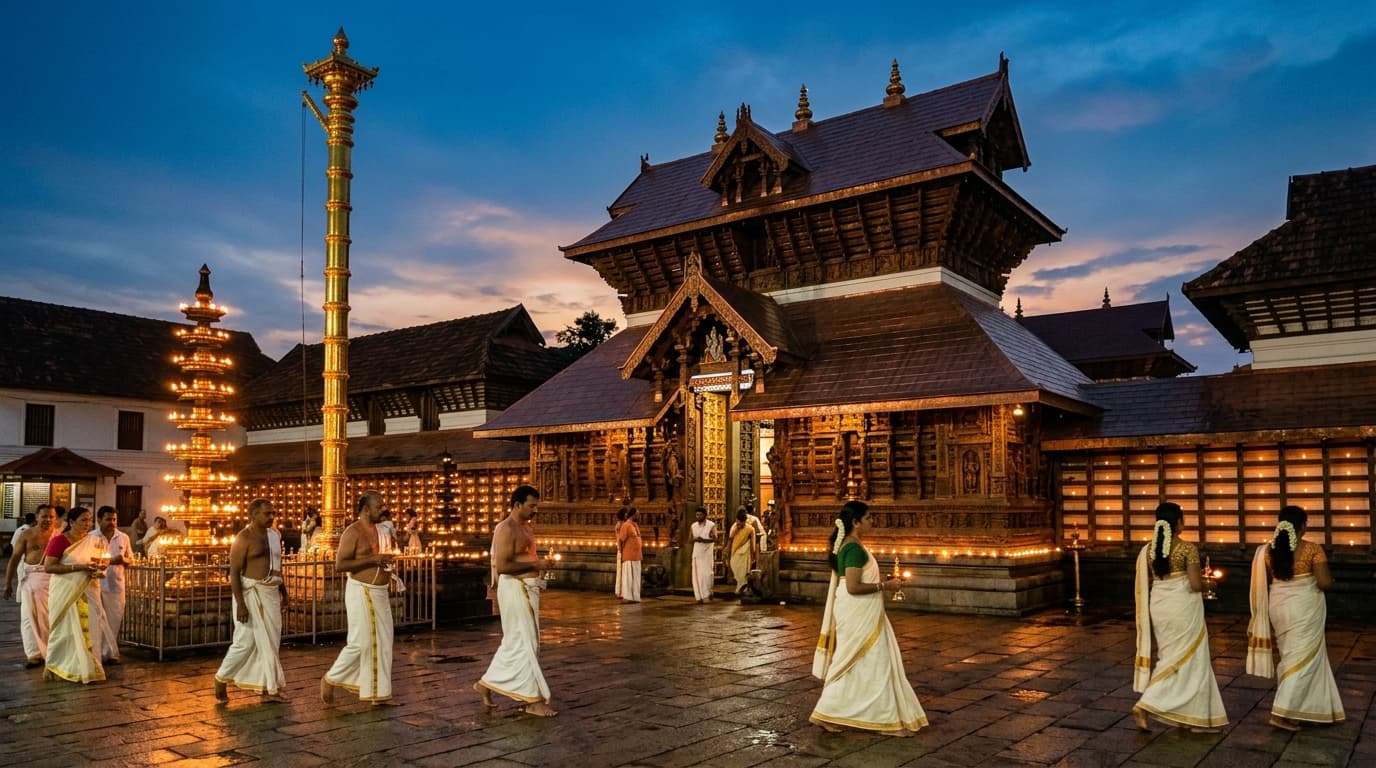
Guruvayur Temple is an architectural masterpiece of classical Kerala Indigenous Vastu design, characterized by sloping timber roofs designed for heavy monsoon rains, ornate gables, granite foundations, and harmonious concentric enclosures.
Sreekovil (Sanctum)
Two-tiered square granite sanctum roofed with gold-plated copper plates, preserving the sacred pathalanjana deity.
Vilakkumatam
A magnificent perimeter trellis holding over 5,000 brass oil lamps, creating an ethereal sea of golden flame during Seeveli.
Dwajasthambam
A 33-metre tall sacred teak flagstaff encased in solid bell-metal and gold, crowned with Garuda facing the sanctum.
Eastern & Western Gopurams
Classic Kerala-style gopurams featuring sloping tile roofs, intricate wooden brackets, and imposing bronze-clad doorways.
Rudra Theertha
The sprawling north-side temple tank where Shiva bathed, used for holy dips (aarattu) and ritual purification.
Deepastambam
The towering 24-foot multi-tiered bronze lamp standing in the outer eastern courtyard holding hundreds of oil wicks.
Bhooloka Vaikuntha:
A Living Temple Today
Guruvayur is reverently celebrated as Bhooloka Vaikuntha (Vaikuntha on Earth)—expressing the enduring belief that the Supreme Divinity is directly accessible to mortals within its sanctum. It is not an archaeological museum of the past, but an active, vibrant spiritual home embracing millions of pilgrims each year.
Unbroken Daily Worship
Rigorous daily poojas commence at 03:00 AM with Nirmalyam Darshan and conclude at 10:00 PM with Thrippuka, preserved through strict Vedic Tantric traditions.
Epicentre of Classical Arts
Home of Krishnanattam Sanskrit dance-theatre, the annual Chembai Sangeetholsavam Carnatic festival, Sopana Sangeetham, and majestic Panchavadyam drum ensembles.
Sacred Life-Cycle Ceremonies
Thousands of families travel here annually for Choroonu (infant first solid food feeding), Vidyarambham (initiation into letters), and traditional temple weddings.
Monumental Annadanam Charity
Feeding up to 10,000 pilgrims daily with free, nutritious consecrated vegetarian meals (Prasada Oottu) in massive community dining halls.
The Complete Story Timeline
Follow the sacred arc from cosmic Vaikuntha to the thriving spiritual town of Guruvayur today.
Vaikuntha
Vishnu fashions the sacred four-armed idol from divine Padmaraga stone and presents it to Brahma.
Brahma
Lord Brahma worships the idol to facilitate cosmic creation and bestows it upon devotee Sutapas.
Sutapas & Prishni
The pious royal couple performs arduous tapasya worshipping the sacred image for divine progeny.
Vasudeva & Devaki
Reborn as Vasudeva and Devaki in Mathura, the Lord manifests as their divine son, Krishna.
Krishna at Dwaraka
Sri Krishna installs and worships the ancient image in His royal temple at Dwaraka.
Dwaraka's Submergence
As Dwaraka is engulfed by the sea, Krishna instructs disciple Uddhava to protect the sacred image.
Guru & Vayu's Mission
Brihaspati (Guru) and Vayu Deva retrieve the floating idol and journey south to find its destined home.
Parashurama
Sage Parashurama welcomes the deities to Bhargava Kshetra (Kerala) and guides them to the lotus lake.
Rudra Theertha & Shiva
Lord Shiva welcomes the idol at the sacred lake, moving to Mammiyur to make way for Vishnu.
Installation of Idol
Brihaspati and Vayu install the idol; Vishwakarma builds the shrine, consecrated as Guruvayur.
King Janamejaya
King Janamejaya is cured of severe leprosy after 100 days of devoted worship at the shrine.
Medieval Documentation
Earliest documentary references to Kuruvayur in Sandesha Kavyas like Kokasandesam.
Narayaneeyam & Bhakti
Melpathur Narayana Bhattathiri composes 1,034 Sanskrit verses of Narayaneeyam in the sanctum.
Wars & Protection
The temple withstands Dutch raids and Tipu Sultan's campaign; deities protected and reinstalled.
Guruvayur Satyagraha
Historic non-violent movement led by K. Kelappan initiating temple-entry reforms in Kerala.
The Fire of 1970
Devastating temple fire where communal human chains saved the sanctum; rebuilt by 1973 Vishu.
Guruvayur Today
A thriving spiritual and cultural epicentre revered across the globe as Bhooloka Vaikuntha.
Plan Your Pilgrimage Visit
The story of Guruvayur is not only preserved in legends and history—it continues through daily worship, offerings, and millions of visiting devotees.
Frequently Asked Questions
Clear, respectful answers explaining the origin, deity identity, Mammiyur connection, and temple history.
Come and Experience
Guruvayur
Now that you know the sacred origin and history, experience the divine grace of Guruvayurappan in person.